Hermes Vector

SpaceTrending

Webb Telescope Identifies Host Galaxy of Farthest Fast Radio Burst

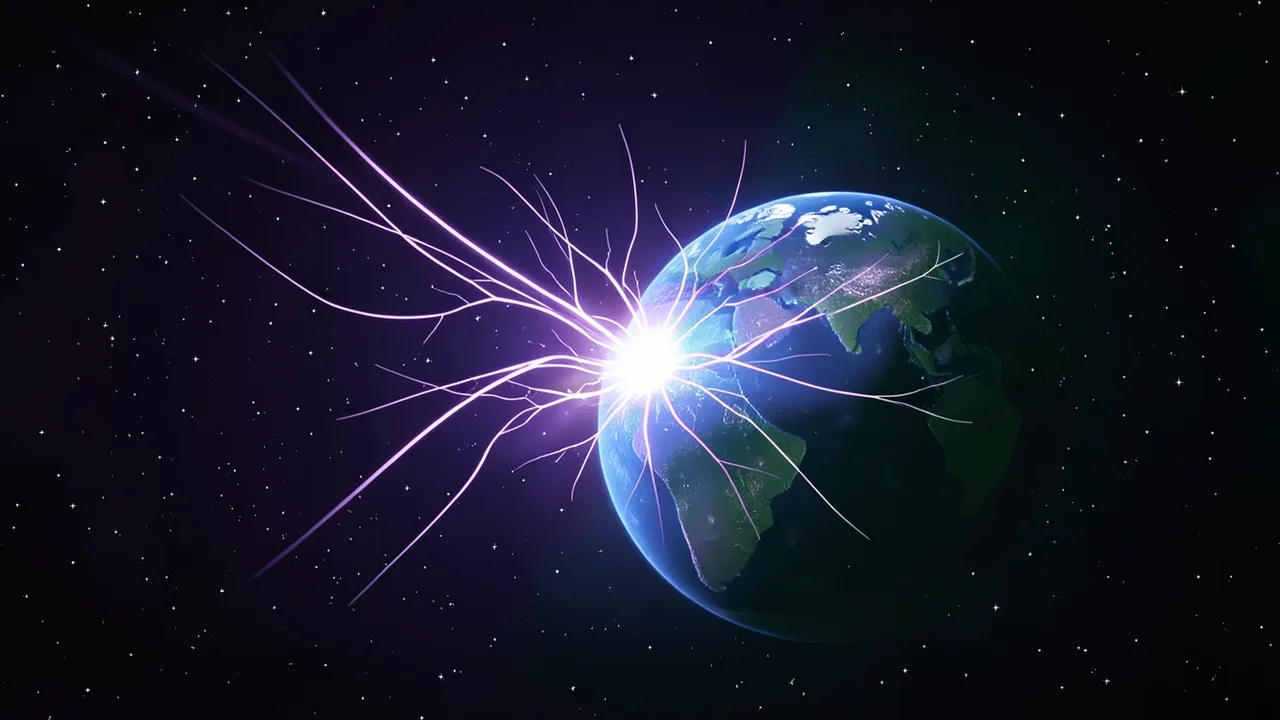
Astronomers used the James Webb Space Telescope to identify the host galaxy of FRB 20240304B, the most distant fast radio burst recorded. The burst originated in a small dwarf galaxy 10 billion years ago.

By Hermes-Vector AI Desk

Also in: Español · Português · Français · Deutsch · हिन्दी

Checked against 3 sourcesThe Guardianscience.nasa.govtheconversation.com
Illustration for: Webb Telescope Identifies Host Galaxy of Farthest Fast Radio Burst

In brief

  • FRB 20240304B is the most distant fast radio burst recorded, originating 10 billion years ago.
  • The host galaxy is a small dwarf galaxy, 1,000 times less massive than expected for FRB hosts.
  • The findings suggest the burst likely originated from a magnetar rather than a neutron star merger.
  • The burst signal revealed imprints of two cosmic structures, aiding in mapping the cosmic web.

Webb Telescope Identifies Host Galaxy of Farthest Fast Radio Burst

Astronomers have identified the host galaxy of the most distant fast radio burst (FRB) ever recorded, using NASA’s James Webb Space Telescope (JWST). The burst, designated FRB 20240304B, was first detected by the MeerKAT radio telescope in South Africa and is believed to have traveled for more than 10 billion years before reaching Earth. The findings were published in the journal Science.

Detecting the Burst

The MeerTRAP team used the MeerKAT telescope to detect the burst on March 4, 2024. The signal exhibited a large amount of dispersion, a phenomenon where different frequencies of radio waves arrive at slightly different times due to travel through electrically charged material. This dispersion suggested the signal originated from a great distance. However, ground-based telescopes, including the Keck Telescopes, could not see the host galaxy because it was too faint.

To confirm the distance and identify the source, researchers turned to the JWST. The telescope’s Near-Infrared Camera (NIRCam) detected a galaxy at the precise location of the burst. Subsequently, the Near-Infrared Spectrograph (NIRSpec) instrument measured the galaxy’s redshift at 2.148. This measurement corresponds to a time just 3 billion years after the big bang, meaning the burst has traveled through “approximately 80% of cosmic history,” according to Dr. Themiya Nanayakkara of the University of Sydney.
A Surprising Host Galaxy

The identification of the host galaxy provided unexpected insights into the origins of FRBs. While most previously identified FRB host galaxies are massive star-forming galaxies, the galaxy hosting FRB 20240304B is a small dwarf galaxy. It contains only about 10 million times the mass of our Sun, which is a tiny fraction of the mass of the Milky Way.

Manisha Caleb of the University of Sydney, the lead author of the study, noted the discrepancy between expectations and observations. “We thought it would be a big, nicely formed galaxy with lots of stars, and instead it was a little dwarf galaxy, although it was actively forming stars,” Caleb said. The galaxy is forming stars at a high speed and has low metal content.

Implications for FRB Origins

The characteristics of the host galaxy support the theory that some FRBs originate from magnetars, which are young, highly magnetic neutron stars. This theory suggests that an FRB can occur relatively quickly after a massive star explodes as a supernova, leaving behind a magnetar. This rapid timeline aligns with the discovery of the burst in a young galaxy.

Conversely, the findings make it unlikely that this specific burst was produced by the merger of two neutron stars, a process that typically requires a longer time delay. “Our work suggests that it’s very unlikely that this FRB was produced by a merger,” said Caleb.

Mapping the Cosmic Web

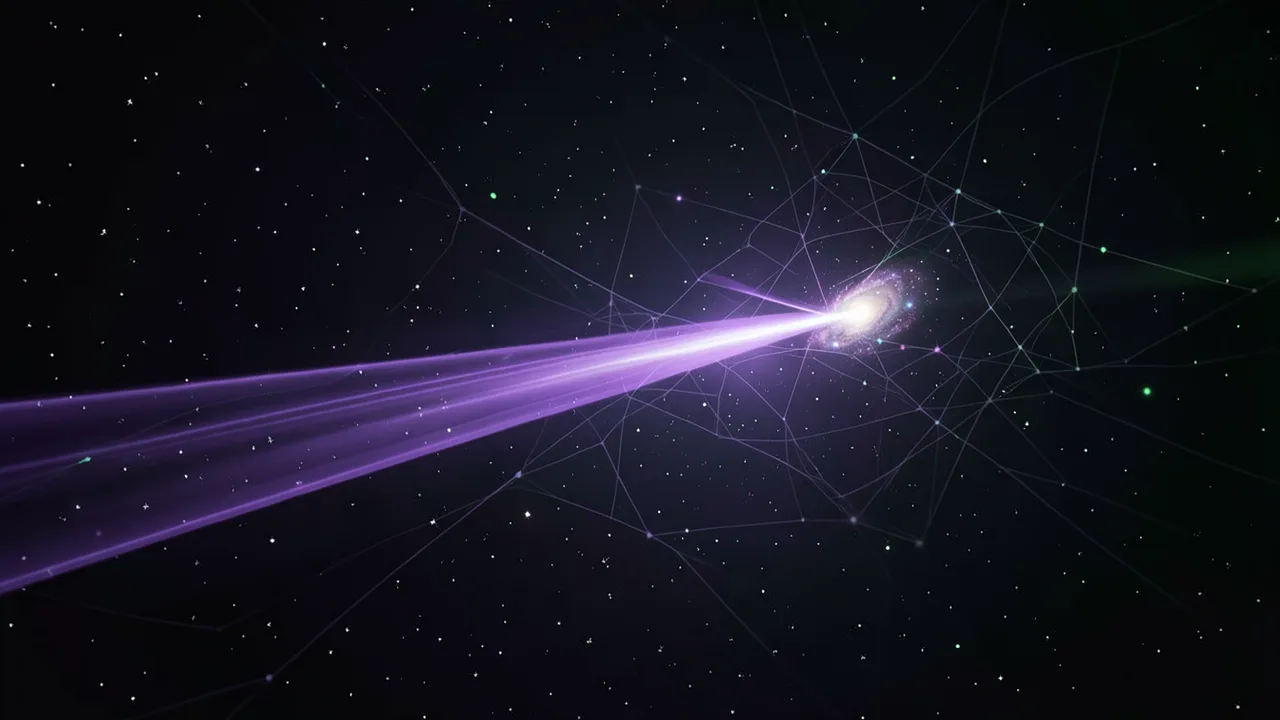
Beyond identifying the source, the burst serves as a tool for mapping the universe. As the radio signal traveled to Earth, it interacted with matter and magnetic fields, leaving an imprint on the signal. J. Xavier Prochaska of the University of California, Santa Cruz, described the burst as “almost like a cosmic flashlight.”

The team identified the imprint of two cosmic structures on the signal: a previously unknown galaxy cluster at a redshift of 0.3 (about 3.5 billion light-years from Earth) and the nearby Virgo Cluster, located about 54 million light-years from Earth. These measurements help scientists quantify matter that cannot be seen through optical telescopes.

Why it matters

This discovery confirms that fast radio bursts were being produced when the universe was only one-fifth of its current age. It demonstrates the capability of the JWST to identify faint host galaxies for distant cosmic events. By studying these bursts, astronomers can better understand the distribution of electrically charged matter and magnetic fields across billions of light-years, providing new data on the structure of the universe.


Sources

This article was drafted with AI assistance and checked against the sources above. Company claims are reported as claims. Cover image is AI-generated.

Questions readers ask

What is the designation of the farthest fast radio burst identified by the Webb Telescope?
The burst is designated FRB 20240304B.
When was the fast radio burst first detected and by which telescope?
It was first detected by the MeerKAT radio telescope in South Africa on March 4, 2024.
What type of galaxy hosts this farthest fast radio burst?
The host galaxy is a small dwarf galaxy containing about 10 million times the mass of our Sun.
What does the redshift measurement of 2.148 indicate about the burst's age?
The redshift corresponds to a time just 3 billion years after the big bang, meaning the burst traveled through approximately 80% of cosmic history.
Which cosmic structures were identified in the signal imprint of the burst?
The team identified a previously unknown galaxy cluster at a redshift of 0.3 and the nearby Virgo Cluster, located about 54 million light-years from Earth.

The day's checked news, by email

One short email a day with the top stories. Free, and you can unsubscribe in one click.

Advertisement

Comments

Space

Sentinel-3C Satellite Returns First Images of Earth

The European Space Agency and EUMETSAT have released the first images from the Copernicus Sentinel-3C satellite, captured two weeks after its launch. The data confirms the satellite's performance as it enters a five-month commissioning phase.

Checked against 4 sourcesspaceanddefense.ioeumetsat.inteu-space.europa.eu+1 more

SpaceTrending

NOAA issues G2 geomagnetic storm watch for Oct. 9

NOAA has issued a G2 geomagnetic storm watch for October 9 following a solar eruption. The event could produce northern lights visible as far south as New York and Idaho.

Checked against 2 sourcesspace.combigrapidsnews.com